

Update note — 8 October 2026: This article explains Meta’s February 2025 announcement. Its 90-day download window and six-month postponement were transition provisions triggered by an account notification, not new deadlines beginning when you read this article. Check the notices and options currently available in your account. The enduring lesson is to keep an independent archive of ministry recordings.
Big Tech is Changing the Rules Again
If there’s one thing we’ve learned about social media, it’s that nothing stays the same for too long. Platforms tweak their policies, shift their priorities, and sometimes pull the rug from under those who rely on them, without much warning. The reason why we must take digital ministry seriously.
In February 2025, Facebook announced a change to Live video storage that affected churches using the platform for services. The announcement is a useful reminder that a publishing platform and a ministry archive serve different purposes. A church should plan for both.
So, What’s Changing?
Here’s the short version:
- Starting February 19, 2025, all new live videos will automatically disappear after 30 days. No more indefinite storage.
- The 2025 announcement also covered older archived Live videos, with removal planned in waves.
- Facebook will notify users before deletion and give them 90 days to download their videos.
- They’re offering bulk download tools to make it easier to save content before it’s gone.
- During the transition, Meta offered a six-month postponement option. Check whether any option remains available in your account rather than assuming a new postponement period begins today.
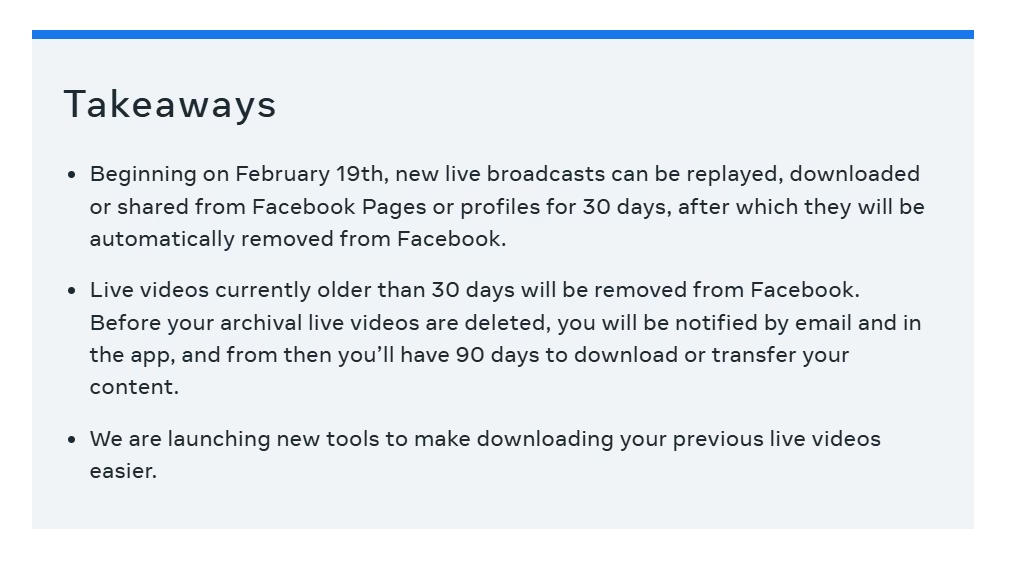
That’s the official update. But let’s talk about what it really means.
Why This Matters for Churches & Ministries
For years, churches have relied on Facebook Live to reach their congregation, engage with people online, and store past sermons. But here’s the hard truth:
- Facebook, like all social media platforms, is a business first—it’s not a ministry partner.
- The platform’s business priorities and service terms may differ from your ministry’s archival needs.
- Review platform policy notices and plan for changes in availability.
Other platforms also set their own storage, access and account terms. This announcement does not establish that YouTube will adopt the same policy. It does establish why a ministry should avoid depending on a single external account for its only copy of important recordings.
What Should Churches Do Now?
This isn’t a call to panic. But it is a wake-up call to start taking digital ownership seriously. Here’s what churches and ministries need to do ASAP:
- Download recordings that remain available and check your account’s current download options. A recording already removed may no longer be recoverable through the platform.
- Stop relying on social media as your only storage space. Start using cloud storage, hard drives, or private ministry websites to keep content safe.
- Explore other video hosting options. Platforms like Vimeo offer long-term storage, while private church apps or websites give more control.
- Think beyond Facebook & YouTube. Email newsletters, podcasts, and private ministry platforms are becoming more important than ever.
- Start planning strategically to build personalized systems for the Gospel. This isn’t about suddenly having a huge budget or advanced tech—it’s about taking small, intentional steps toward ownership.
- Begin with something as simple as a ministry website. Instead of relying on third-party platforms to reach people, start growing a following on your own digital space.
A Practical Archive Routine
Assign someone to keep an original recording after each broadcast. Store a working copy and a separate backup, use a consistent date-and-topic filename, and test that the files can be opened. Record who controls the storage account and how the ministry will retain access when volunteers change. Social media can distribute the message while your archive preserves it.
Final Thoughts: The Time to Act is Now
For too long, the Church has borrowed digital space instead of claiming digital ground. We’ve treated social media as a free tool instead of recognizing that we don’t own these platforms—and at any moment, the rules can change.
This isn’t just about Facebook deleting videos. This is about long-term digital sustainability for ministry.
If ministries don’t take action now, we will see more of these changes disrupt how the Gospel is spread online. We must stop being reactive and start being proactive.
So, here’s the charge: Download your videos, rethink your digital strategy, and start building your own platform. It may not happen overnight, but every step in this direction is a step toward securing the future of digital ministry.
The question isn’t if the Church should adapt. The question is how long will we wait before we do?