


There is a moment in the book of Acts that I keep returning to. Paul, standing in the Areopagus, does not wait for Athens to come to him. He goes to where the conversation is already happening, listens carefully enough to quote their own poets back at them, and then introduces them to something they had not yet named. He was, in the fullest sense of the word, present. That posture, more than any strategy or platform, is what digital ministry requires of us today.
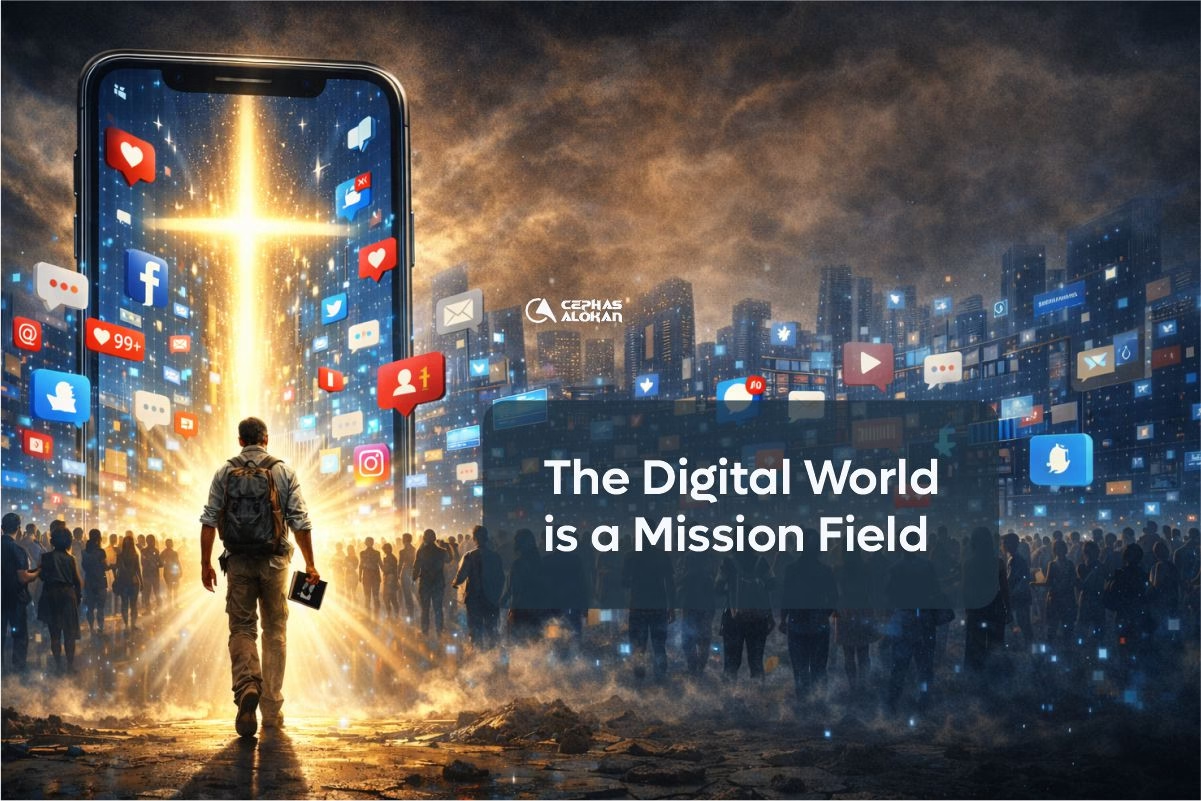
The digital world is today’s mission field. Not because it is trendy to say so. Not because every ministry needs a social media presence. But because that is where a significant portion of human interior life now unfolds, and the church has always gone where people actually are.
Where People Actually Are
For most of Christian history, presence was geographic. You sailed to a continent, walked into a village, learned a language, and stayed. That model still matters deeply. But something has shifted in our generation that we are only beginning to reckon with theologically.
Billions of people now spend formative hours of their day in digital spaces. Not passively consuming entertainment, though that happens too. They are processing grief in comment sections. They are asking questions about God and doubt and suffering in forums they would never voice in a church foyer. They are finding community in places that feel safer than any physical room they have ever entered.
This is the reality of digital ministry: the people we are called to reach are not waiting for us to find a better Sunday morning format. They are already somewhere, already searching, already being formed by whatever voices show up consistently in their feeds. The question is simply whether faithful voices will be among them.
The Unprecedented Reach of Digital Spaces
Here is something worth sitting with.
- A woman in a rural village in Southeast Africa who would never step into a church building, who has no Christian neighbor, no access to theological education, can encounter a faithful explanation of the resurrection at two in the morning on her phone.
- A teenager in a secular European city, raised with no religious framework whatsoever, can stumble across a thoughtful conversation about faith and find themselves genuinely moved.
That reach is not a small thing. It is, historically speaking, extraordinary. The Great Commission has always carried with it an implicit logistical problem: how do you reach every nation with finite human bodies and limited resources?
Digital spaces do not solve that problem entirely, but they compress it in ways that should produce in us not anxiety but wonder.
Effective digital ministry understands this as opportunity, not obligation. The goal is not to be everywhere online. The goal is to be genuinely present in the spaces where your particular voice and calling can do the most good.
A Contested Space, Not a Neutral One
And yet we have to be honest about what we are walking into. The digital world is not a blank canvas waiting for the church to arrive and fill it with good content. It is a deeply formed environment with its own values, its own liturgies, and its own vision of human flourishing.
The algorithms that carry your message to someone in darkness are the same algorithms designed to exploit attention, amplify outrage, and monetize insecurity. The formation happening in digital spaces, hour by hour, often runs in direct opposition to the patient, embodied, long-suffering character that the gospel actually produces.
This means digital ministry is not simply about finding a new distribution channel for old content. It requires the same theological seriousness that cross-cultural mission has always demanded.
The missionary who goes overseas must develop cultural fluency: what does this culture assume about authority, truth, shame, community? The minister working in digital spaces must ask the same questions. What does digital culture assume about authenticity? About speed? About who deserves a platform? About what it means to be known?
Those assumptions are not neutral. And faithful digital ministry means engaging them directly, gently, persistently, rather than simply importing church culture into a new medium and hoping for the best.
What This Actually Requires
The practices of digital ministry are not complicated, but they are demanding. A few things matter above everything else.
- Genuine presence over performative output.
The most effective voices in digital spaces are not the ones producing the most content. They are the ones who show up consistently enough that people come to trust them. That trust is built the same way it has always been built: by being honest, by being present during difficult moments, by saying true things even when true things are unpopular.
- Fluency in the culture without absorption by it.
This is perhaps the central tension of digital ministry. You must understand how these platforms work, what kinds of communication land and why, what the dominant anxieties and questions of the moment are. And you must hold all of that with enough theological rootedness that you are shaping the conversation rather than simply being shaped by it.
- Sustainability as a spiritual discipline.
Burnout in digital ministry is real and it is common. The platforms are designed to reward volume and punish absence. Learning to be present without being consumed is not just a productivity question. It is a spiritual formation question. The minister who cannot protect their own interior life will eventually have nothing to offer the people they are trying to reach.
The Same Call, a New Context
Every generation of the church has faced the same essential question: where are the people, and how do we go to them faithfully? The Reformers had the printing press. The twentieth century church had radio and television. We have the internet, social media, and tools we are only beginning to understand.
The call is not new. The context is. And the church has always found its way when it held the call firmly and held the context with open hands, learning what needs to be learned, adapting what can be adapted, and refusing to surrender the things that cannot be surrendered.
Paul went to the Areopagus because that is where the conversation was. He did not go to win an argument. He went because he genuinely believed the people there were worth the journey. That posture, more than any algorithm or content strategy, is still the heart of what it means to do digital ministry well.
The field is open. The harvest language of Jesus was never metaphorical about scarcity. It was always about abundance and the need for more workers willing to show up.
The digital world needs workers willing to show up.