

There is a conversation happening in leadership circles that almost never gets the attention it deserves. We talk endlessly about vision, strategy, executive presence, and building high-performing teams. We celebrate the ones at the front. But somewhere along the way, we skipped a chapter, and that missing chapter is quietly costing us the very leaders we are trying to develop.
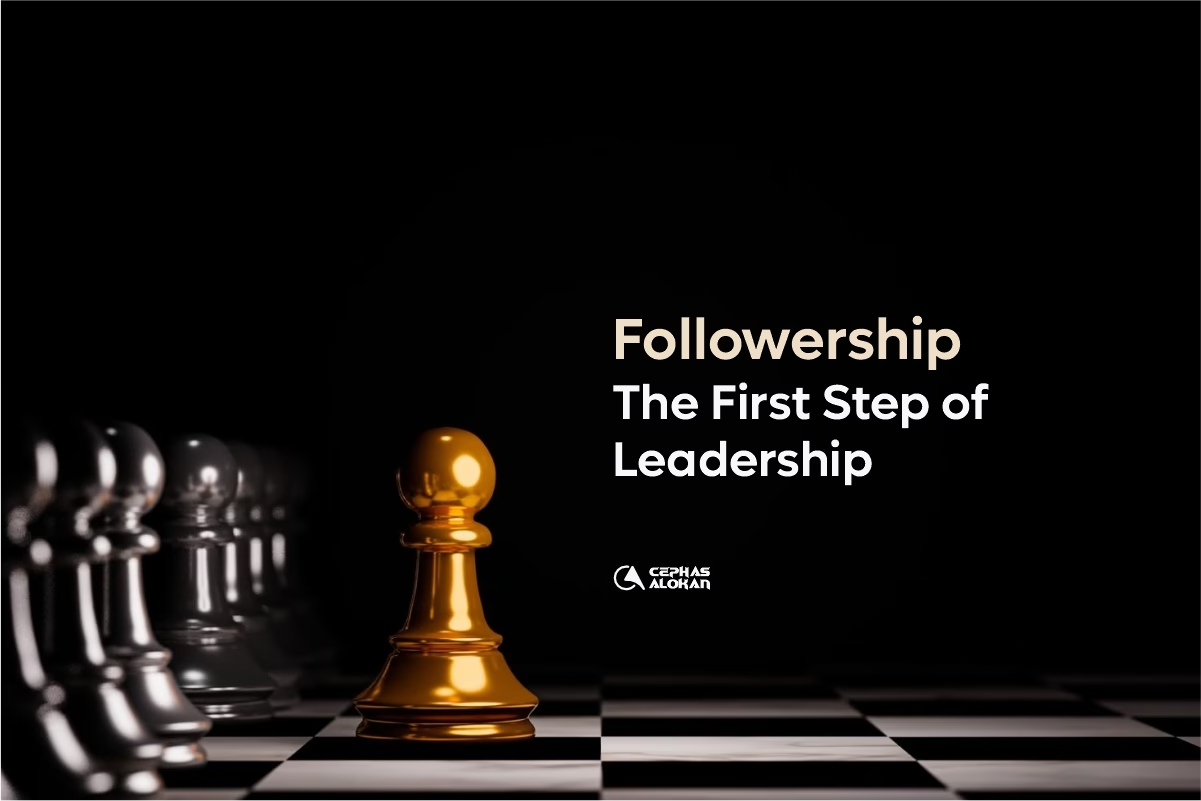
The chapter is this: before you are ever qualified to lead others, you must first learn to follow well.
This is not a popular message. But it is a foundational one. And if you have spent any time studying the lives of great leaders, whether in Scripture, in history, or in the organizations around you, you already know it to be true.
Faithful Followership Is Not a Phase You Graduate From
One of the most dangerous myths in leadership development is that followership is a temporary condition. We frame it as a starting point, a waiting room you endure before your real leadership life begins. But faithful followership is not a ladder rung you kick away once you have climbed high enough. It is a posture you carry with you, all the way to the top and stay there with it.
Consider the life of David. Before he ever sat on a throne, he spent years tending sheep in obscurity, serving Saul with honor even when Saul did not deserve it, and waiting on God’s timing rather than forcing his own. His faithful followership was not a detour on the way to leadership. It was his leadership training. Every decision he made as king was shaped by what he had learned in seasons of submission.
The same principle shows up in secular leadership research. Studies on leader development consistently point to the quality of early professional experiences, particularly how emerging leaders learn to take direction, respond to feedback, and operate within authority structures, as strong predictors of their effectiveness later on.
What Faithful Followership Actually Looks Like
Faithful followership is not passive compliance. It is not blind obedience. And it is certainly not the absence of voice or perspective. What it is, at its core, is the disciplined practice of honoring the authority and vision of those you serve, while bringing your whole, excellent self to the work.
That looks like a few specific things in practice:
- Doing excellent work even when no one is watching. The person who cuts corners when unsupervised will cut corners when they are the supervisor. Faithfulness in small things is not just good character. It is a preview of what your leadership will produce.
- Serving the vision, not just your role. Followers who are genuinely faithful are not narrowly focused on their job description. They understand the larger mission and actively contribute to it, even when it is inconvenient.
- Receiving corrections with humility. How you handle feedback when you are following reveals exactly how you will give it when you are leading. The leader who gets defensive when corrected will create a culture where no one dares to speak truth upward.
- Honoring leadership even in disagreement. There is a profound difference between raising a concern through proper channels and quietly undermining those above you. One builds trust. The other erodes the very culture you will one day be responsible for.
The Spiritual Dimension of Followership
For those of us who operate from a faith framework, the call to faithful followership carries even deeper weight. Luke 16:10 presents a principle that is as practical as it is spiritual: “Whoever can be trusted with very little can also be trusted with much.” This is not a motivational quote. It is a governing law of how leadership authority is extended and sustained.
What you do in the hidden seasons, in the roles no one applauds, in the moments when faithfulness costs you something, that is what forms the character that your future leadership will rest on. Shortcuts taken in the followership stage do not disappear. They resurface as cracks in the foundation once the weight of leadership is fully on you.
This is also why spiritual formation and leadership development cannot be separated. The inner work of surrender, patience, and trust in God’s process is not separate from your leadership journey. It is the silent foundation beneath everything else.
Why So Many Leaders Skip This Step
If faithful followership is this important, why do so many emerging leaders resist it? Honestly, because it is uncomfortable. It requires you to subordinate your ego to someone else’s vision. It demands patience in a culture that rewards speed. It asks you to be excellent without recognition, and to trust that the season of obscurity is doing something in you that visibility never could.
There is also a cultural pressure, particularly in entrepreneurial and ministry contexts, that glorifies the maverick. The one who does not need to follow because they are destined to lead. But this is a narrative that has produced, with remarkable consistency, leaders who are talented and fragile, innovative and unteachable, inspiring to follow and painful to work with.
The antidote is not to strip ambition out of emerging leaders. It is to channel that ambition through the discipline of faithful service. Ambition that has been refined through followership becomes something sustainable. Ambition that bypasses it tends to burn everything around it.
A Word to Those Currently in the Followership Season
If you are reading this and you are in a season where you feel overlooked, underutilized, or frustrated with how slowly things seem to be moving, I want to say something directly to you: this season is not a waste.
The work you are doing right now, the faithfulness in small tasks, the excellence in unseen moments, the discipline of honoring leadership even when it is imperfect, it is forming something in you that no shortcut can produce. You are not behind. You are being built.
Lead where you are. Serve with your whole heart. And trust that the foundation being laid in this quiet season is the very thing that will hold the weight of everything that comes next.
Because the leaders who last, who truly build something that outlives them, are almost always the ones who first learned to follow well.
What has your followership journey taught you about leadership? I would love to hear your story.