

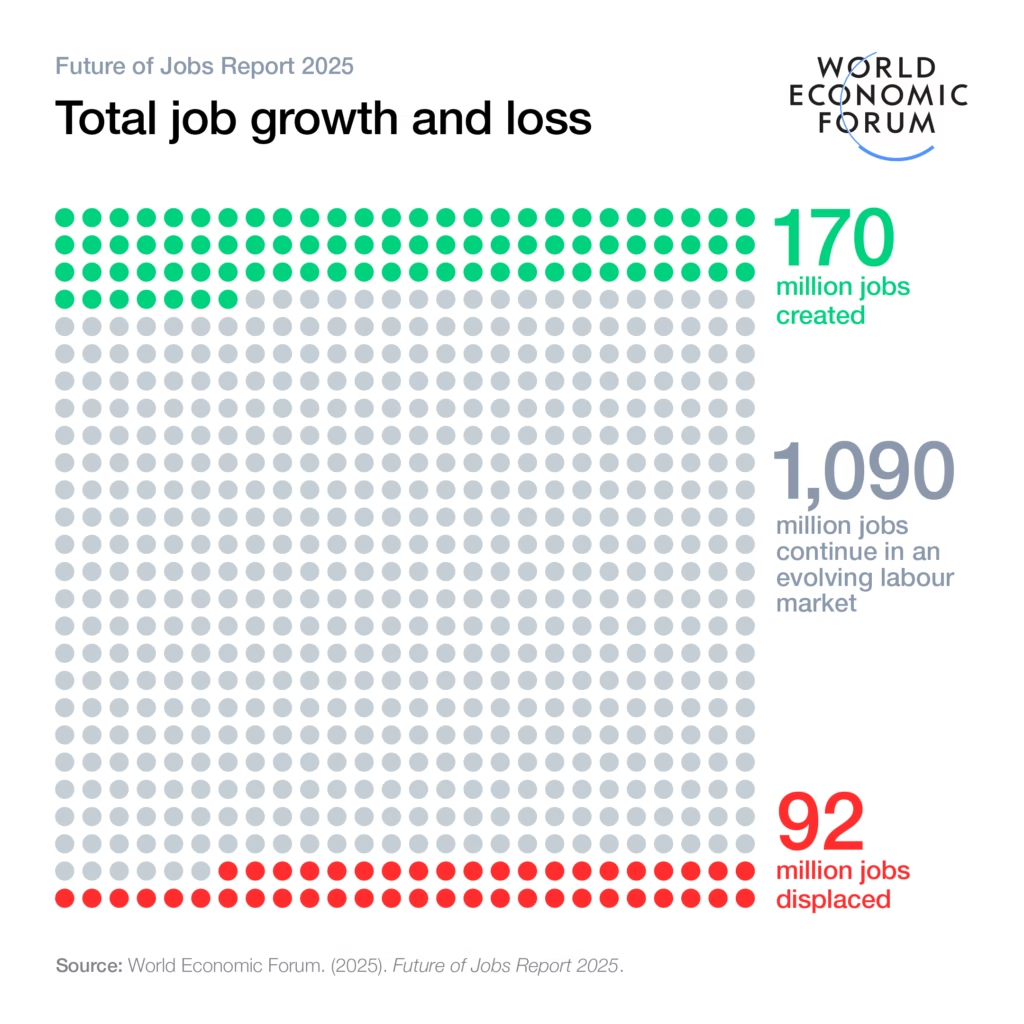
The World Economic Forum’s Future of Jobs Report 2025 projects that wider labour-market trends could create 170 million jobs and displace 92 million by 2030, a net gain of 78 million. These are projections covering several economic and technological forces, not a count of jobs lost to AI alone.
That is not a distant possibility. It is a current reality unfolding before our eyes.
Artificial intelligence, automation, and digital transformation are tectonic shifts that are redrawing the map of global work, influence, and innovation. The rise of generative AI tools like ChatGPT, Copilot, and Midjourney is just a hint of where things are headed.
If you’re still working, planning, or building with a 2020 mindset, you may already be behind. Because while many are trying to catch up with today, others are quietly preparing for 2030.
So here’s the real question—are you one of them?
Yesterday’s Innovation Is Today’s Norm
What amazed us yesterday is already outdated. What was considered groundbreaking just five years ago is now standard, and in a few more years, it may be obsolete. That is how quickly things are moving.
Some people continue to plan around methods that no longer serve their work well. Others are learning how their field is changing and preparing for new responsibilities. The aim is not to abandon every established practice, but to know what remains useful, what needs improvement and what you should learn next.
Generative AI Is Reshaping Everything
Tools like ChatGPT, Meta AI, Microsoft Copilot, and Midjourney are no longer experimental—they are being adopted at scale. These technologies are changing how we write, design, code, analyze data, and make decisions. AI is no longer just a support tool. It is becoming a co-worker, a strategist, and in some cases, a builder.
AI-assisted coding, writing and analysis can reduce the time needed for some tasks. The result still requires people who understand the work, can check its quality and remain accountable for decisions. The useful question is which tasks a tool can assist in your field and what expertise you need to use it well.
This is the world we are entering. The question is not whether this will happen. It already is. The question is: are you ready?
A Wake-Up Call for Christians in the Marketplace
As believers in business, leadership, education, ministry, or any field, this is not a time to ignore what is happening. We cannot afford to pray and plan only within the confines of the familiar. We must also discern what is coming.
Remember Joseph in Egypt. His advantage was not just that he heard from God. It was that he interpreted what was ahead and positioned himself accordingly. That wisdom preserved nations. That kind of foresight is what we need today.
The Future of Jobs: What the Data Says
The report’s projections underline the need for preparation, but they do not predict what will happen to every person or profession. Look at the tasks changing in your field, the skills employers need and the responsibilities that still require human judgment. Use the report as a guide to learning rather than a guarantee about your job.
The skills that will be in highest demand are already visible:
- Analytical thinking and innovation
- Artificial intelligence literacy
- Creativity and originality
- Emotional intelligence
- Digital communication
- Strategic thinking
- Resilience and adaptability
The marketplace is evolving. The future belongs to those who are paying attention and preparing in advance.
What You Should Be Doing Right Now
If some tasks in your role can be automated, examine how the role may change. Automation does not necessarily remove an entire job, and adoption depends on cost, reliability and organisational choices. Strengthen the judgment, relationships and specialist knowledge that help you contribute as the work develops.
- Audit your current role. Ask yourself how AI can assist or elevate what you do. In most cases, it can.
- Learn how these tools work. Do not wait to be left behind. Experiment. Get comfortable using AI.
- Reskill or upskill. If your current skill set feels outdated, invest in new ones. Do not be emotional about your future. Make the shift.
- Stay alert to industry trends. Your industry might not be dead, but it may be shrinking. That is a sign to pivot.
- Invest in knowledge. Take online courses. Attend industry workshops. Join communities that are growing in your area of interest.
- Stay humble and teachable. In this age, the fastest learners—not just the most gifted—will lead.
The Spiritual Mandate to Prepare
As a Christian, your calling is not just to survive disruption. You are called to bring light and solutions in the middle of change. That means you must understand the times like the sons of Issachar and know what to do.
Foresight is a spiritual gift and a practical skill. You cannot lead with yesterday’s wisdom in tomorrow’s world.
Don’t Wait for the Future—Prepare for It
This is not just a shift in tools. It is a shift in times. What we are experiencing now is just the shadow. The real disruption is still ahead.
You cannot afford to wait until it hits you. You must prepare while there is still time.
Do not treat learning like a luxury. Treat it like preparation for war. Take action now so that when the future comes, you are not trying to catch up—you are already leading in it.